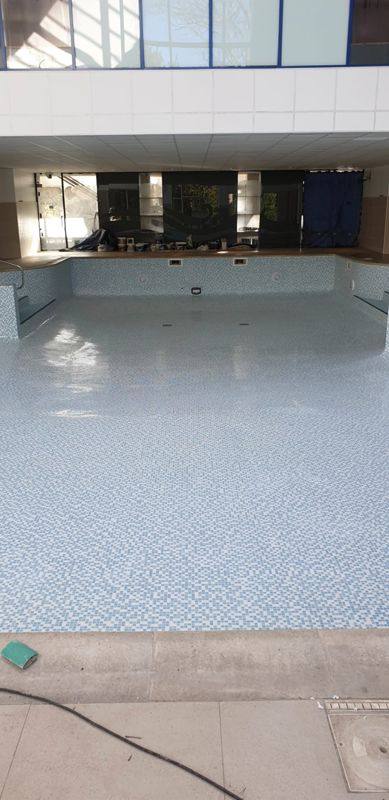
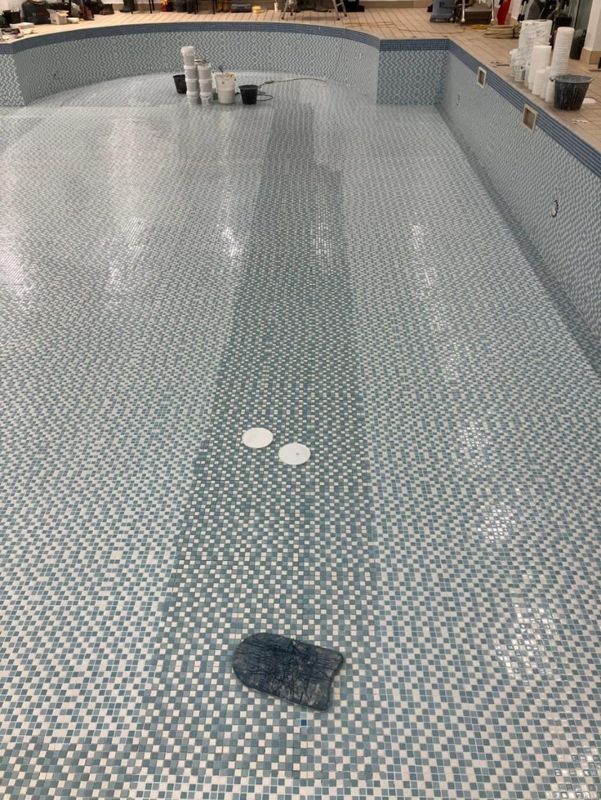
On epoxy vs cement grout for swimming pools, epoxy generally stands up better to pool chemicals, soft or aggressive water and staining, which is why it is common in pool tanks. It is not automatically the right choice: it is harder to install well and harder to remove later. A good polymer-modified cement grout still suits some pools and many surrounds.

The short answer
Both epoxy and cementitious grouts are used in swimming pools. The right choice depends on the tile, joint size, water conditions, how the pool is used and cleaned, and the installation conditions on site. Neither type has a guaranteed lifespan.
Much of our regrouting is done in epoxy, but the product changes from job to job, and where a cement grout suits the specification we will say so.
How cement grout behaves in a pool
Cement-based grouts set by hydration and stay slightly porous. Modern polymer-modified products made for pools are much better than old sand and cement joints, but they can still be attacked by water that is out of balance, particularly soft or low-calcium water, and by strong descaling products used without care.
When that happens the surface erodes, joints become sandy and recessed, and the porous surface becomes easier for dirt and algae to cling to. With good water management and suitable cleaning, a well-installed cement grout can still give reasonable service.
How epoxy grout behaves in a pool
Epoxy grouts are two-part (or sometimes three-part) systems that cure by chemical reaction into a dense, low-porosity joint. They are generally much less affected by pool water chemistry and many cleaning products, and they tend to resist staining better.
The trade-off is in installation. Epoxy has a limited working time, is sensitive to temperature, and must be cleaned off the tile face within its working window or it can leave a stubborn haze. On textured or porous tiles that cleaning can be harder still.
Side by side
These are general tendencies, not rules. The specific product data sheet always takes priority.
- Chemical and aggressive water resistance: epoxy usually performs better.
- Stain resistance and ease of cleaning: epoxy usually performs better because it is less porous.
- Ease of installation: cement grout is more forgiving; epoxy needs experience, timing and the right conditions.
- Future removal: cured epoxy is harder to rake out if the pool is regrouted again.
- Material cost: epoxy systems are typically more expensive per joint, though labour and closure time often matter more overall.
- Fixing underlying faults: neither type can secure a loose tile, absorb structural movement or waterproof a leaking shell.
What epoxy cannot do
Epoxy gets sold as a cure-all. It is a joint filler. If tiles are hollow, the background is breaking up or movement joints are missing, an epoxy regrout will not hold the surface together, and it does nothing for a shell that leaks.
Epoxy is also rigid. It should not be used to fill movement or perimeter joints, which need a flexible sealant system suitable for immersion.
When cement grout can still make sense
Cement grout is commonly used on pool surrounds, changing areas and other wet floors where it is not permanently immersed, and where its easier cleaning during installation suits the tile. Some owners also prefer it for pool interiors where the selected product and specification are suitable and the water is well managed.
If cement grout is chosen, it is worth agreeing a maintenance routine at the start. That includes keeping water balanced and avoiding cleaning products that will attack the joint.
Questions to settle before choosing
Start with the pool, not the product. Why the current grout failed tells you most of what you need to know about what will last.
- What has happened to the existing grout, and why?
- Are the tiles well bonded across the areas being regrouted?
- What tile is it: glazed ceramic, porcelain, glass mosaic, textured anti-slip?
- How wide and deep are the joints?
- What temperature and humidity can be maintained while the grout cures?
- How is the pool cleaned, and with what?
Installation matters as much as the product
A premium grout installed badly can fail sooner than a modest one installed well. Joints need raking out to an adequate, consistent depth, cleaning of dust and old material, and filling fully so there are no hollows behind a neat surface.
Temperature and humidity in a drained pool hall affect working time and cure, particularly with epoxy. Heating, ventilation or dehumidification may need agreeing with the operator so conditions stay within the manufacturer's range.
Then the grout needs its full cure. Refilling early, or dosing chemicals before the data sheet allows, can undo careful work, so we do not cut that time short to hit a reopening date.
Common questions
Epoxy vs cement grout for swimming pools: which lasts longer?
In pool water, epoxy usually outlasts cement grout because it is denser and far less affected by water chemistry. That only holds if it is installed and cured properly. A well-fitted cement grout in a well-run pool can outlast a rushed epoxy job, and neither has a guaranteed lifespan.
Does epoxy grout last forever in a pool?
No. Epoxy is generally more durable than cement grout in pool water, but no grout has a guaranteed lifespan. Preparation, installation, curing, water chemistry and cleaning all affect how long it performs.
Can epoxy be applied over old cement grout?
It should not simply be skimmed over the top. The old grout needs removing to an adequate depth and the joint cleaning so the new grout can fill and bond properly. The manufacturer's guidance sets the requirements.
Does epoxy grout discolour?
It is usually more stain resistant than cement grout, but it can still pick up surface dirt or scale and some colours show marks more than others. Product data sheets give guidance on colour stability and suitable cleaners.
Should the surround use the same grout as the pool?
Not necessarily. The surround is not permanently immersed and has different demands, such as slip resistance, foot traffic and cleaning chemicals. The grout for each area is chosen for its own conditions.