Swimming pool tiles falling off means the bond has failed somewhere in the build-up: patchy adhesive coverage, an adhesive not suited to immersion, movement with nowhere to go, render parting from the shell, or water working into the bed over years. Sticking the tile back on rarely lasts unless you find out which of these caused it.
The tile is only the visible part
A tiled pool is a layered system: the shell, often a render or screed, sometimes a membrane, the adhesive bed, the tile and the grout. A tile falling off means the bond has failed at one of those interfaces.
The back of a fallen tile, and the surface it came off, tell you a lot. Adhesive stuck to the tile with a clean background behind usually means the bond to the background failed, often because of dust, laitance or a weak render face. A clean tile back with combed ridges left on the wall suggests the adhesive had skinned over, or the tile was never pressed firmly into it.
Common causes
More than one of these is often involved, and they can reinforce each other.
- Adhesive coverage: tiles fixed with dabs or a thin, uneven bed leave voids, and those voids can fill with water.
- Unsuitable or poorly mixed adhesive: not every adhesive is suited to permanent immersion or pool conditions.
- Background problems: render or screed that is weak, contaminated or separating from the shell takes the tiles with it.
- Movement: thermal changes, shrinkage of the background and structural movement put stress on the tiling if movement joints are missing or ineffective.
- Water and chemistry: open grout joints and aggressive water can let the bed deteriorate over time.
- Operational stress: draining, filling or heating a pool too quickly adds stress, which is why BS 5385-4 and pool specifications limit these rates.
Patterns worth noticing
Single tiles falling off here and there may point to local defects in the original installation. Lines of loose tiles along wall and floor junctions, steps or corners often suggest movement. A whole area sounding hollow and coming away with render attached points to the background.
Tiles that start falling off shortly after a drain-down, refill or heating change are worth recording, because timing can help diagnose the cause.
Mosaic and sheet-mounted tiles
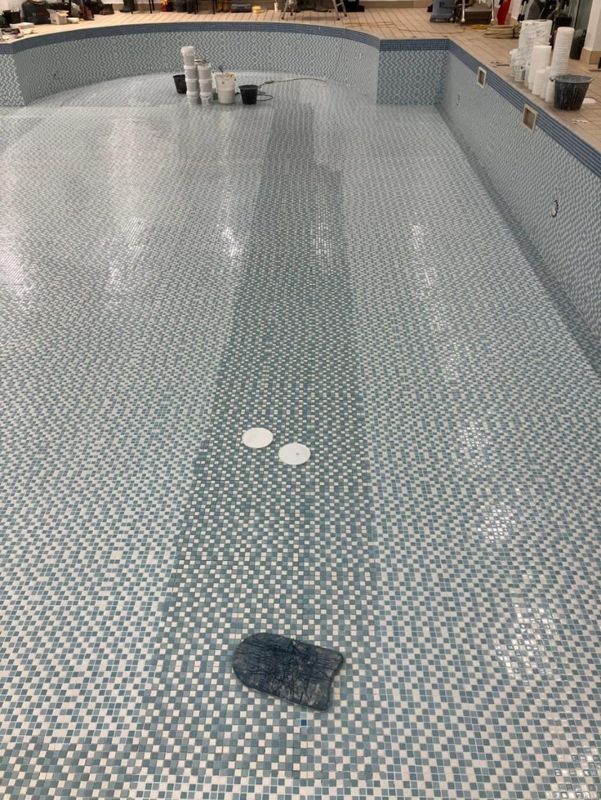
Pool mosaic comes in sheets, either face-mounted on paper that is soaked off after fixing or back-mounted on mesh or dots. Some back-mounting systems cover enough of each piece to cut the bonded area, and not all are suited to permanent immersion. Sheets that were not beaten fully into the bed can also leave pieces poorly bonded, even where the area looked sound at first.
Mosaic also has far more joints than larger tiles, so grout condition has a bigger influence on how much water reaches the bed. On curved walls and steps, where mosaic is common, it is worth checking the edges of each sheet as well as the individual pieces.
Why regrouting will not fix it
Grout fills joints. It does not hold a tile to the wall. Regrouting around a loose tile can make the pool look tidy for a time, but the tile can still move, crack the new grout and eventually come away.
Deal with loose and hollow tiles first, or as part of the regrout, never after it.
How a local repair is carried out
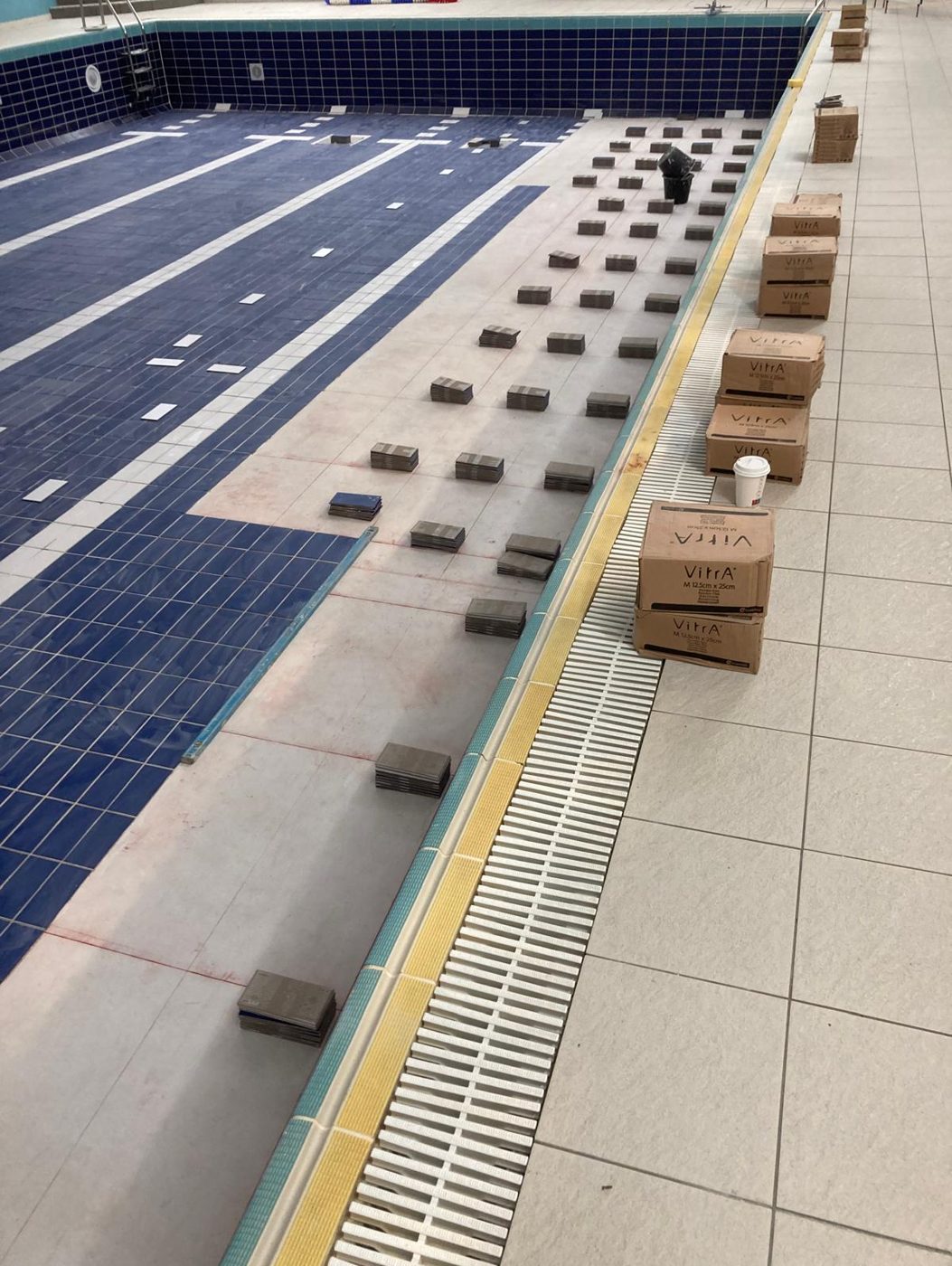
Where the surrounding work is sound, Dan or Jay will cut out the grout and lift the loose tile without disturbing its neighbours. Old adhesive is chased out and the background checked.
If the background is firm, the tile or a matching replacement is back-buttered and bedded solid in a compatible adhesive, then grouted once the adhesive allows. If the background is unsound, the repair carries on until sound material is reached, which is why nobody can say exactly where it stops until the first tile is up.
When it is more than a local repair
If testing shows large areas of hollow tiles, or render coming away across a wall, a larger refurbishment or retile may be the more reliable option. Missing movement joints may also need forming as part of the work.
Problems with the structure or the waterproofing of the shell need assessing separately, sometimes by a structural engineer. Tiling can only perform as well as what it is fixed to.
What owners and operators can do
Keep a simple record of where and when tiles come loose, and keep any tiles that fall off. Keep water balanced and follow the pool's specification for draining, filling and heating.
If tiles are loose in areas that bathers walk on or hold onto, such as steps, edges and floors, it is sensible to have them assessed promptly.
Common questions
Why are my swimming pool tiles falling off?
Because the bond between tile, adhesive and background has failed somewhere. Look at the back of a fallen tile and the surface it came from: adhesive left on the wall, on the tile, or render coming away with it each point to a different cause, and a different repair.
Can a loose pool tile be stuck back on underwater?
Some products are sold for underwater repairs and can hold a single tile as a stopgap. They do not let anyone see the bed or background, so whatever caused the problem is still there.
If one tile comes loose, will others follow?
Not necessarily, but it is a prompt to look more widely. A tap test of the surrounding area when the pool is next drained can show whether the problem is isolated or more widespread.
Is a loose tile a safety issue?
It can be. Loose or missing tiles can leave sharp edges and trip points, especially on steps, floors and edges. Operators usually assess the risk and may restrict use of an area until it is repaired.
Can I reuse the tiles that fell off?
Sometimes, if they are undamaged and can be cleaned back properly. Otherwise a matching replacement is needed, which can be harder for older or discontinued tiles.