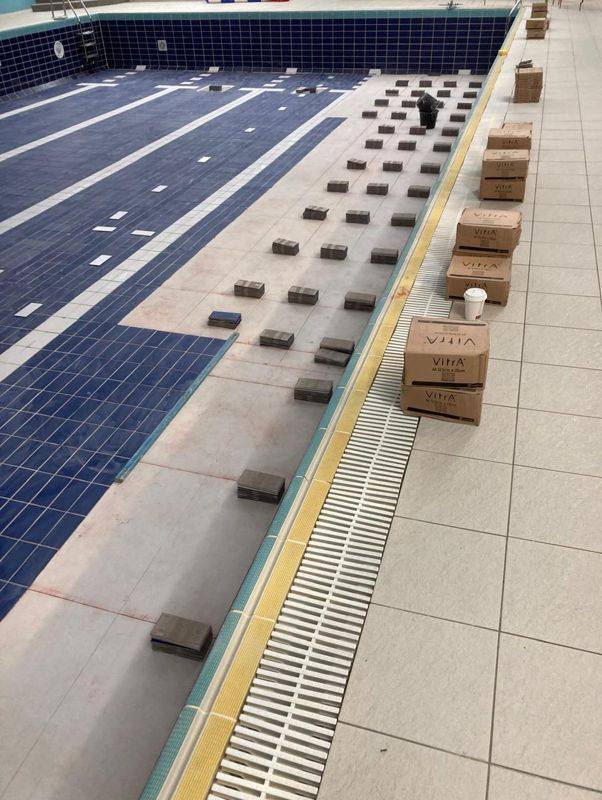
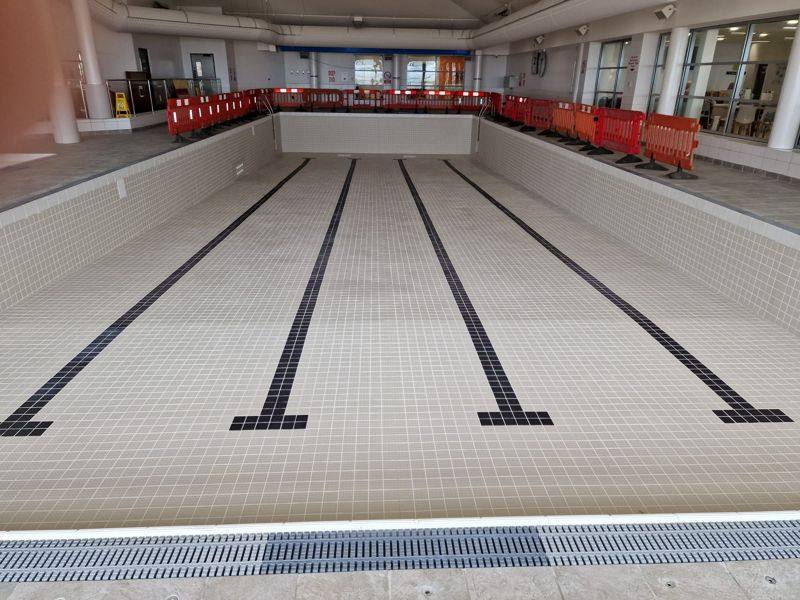
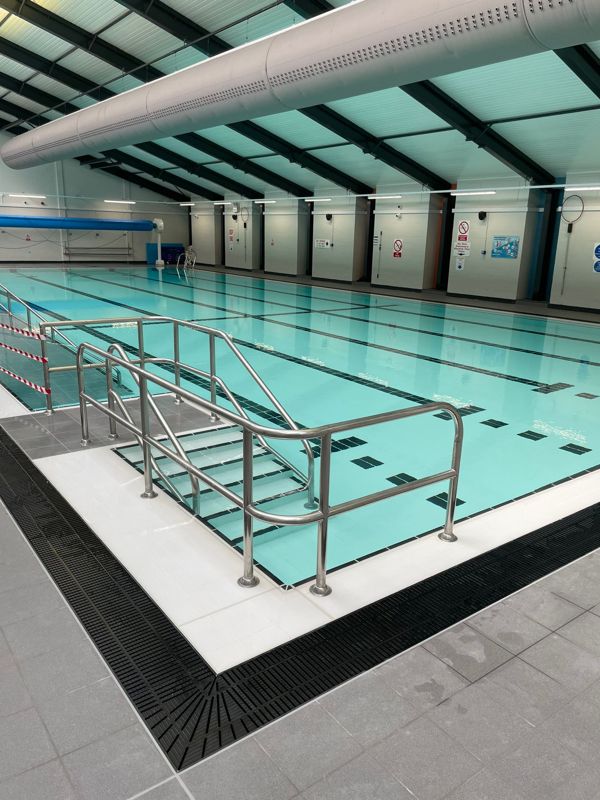
You can tile over existing pool tiles only in narrow circumstances, and in a pool that stays full of water it is usually not advisable. It could only be considered where every existing tile is soundly bonded and the adhesive system manufacturer specifically supports tile-on-tile for permanent immersion. The usual right route is to strip, repair the background and retile.
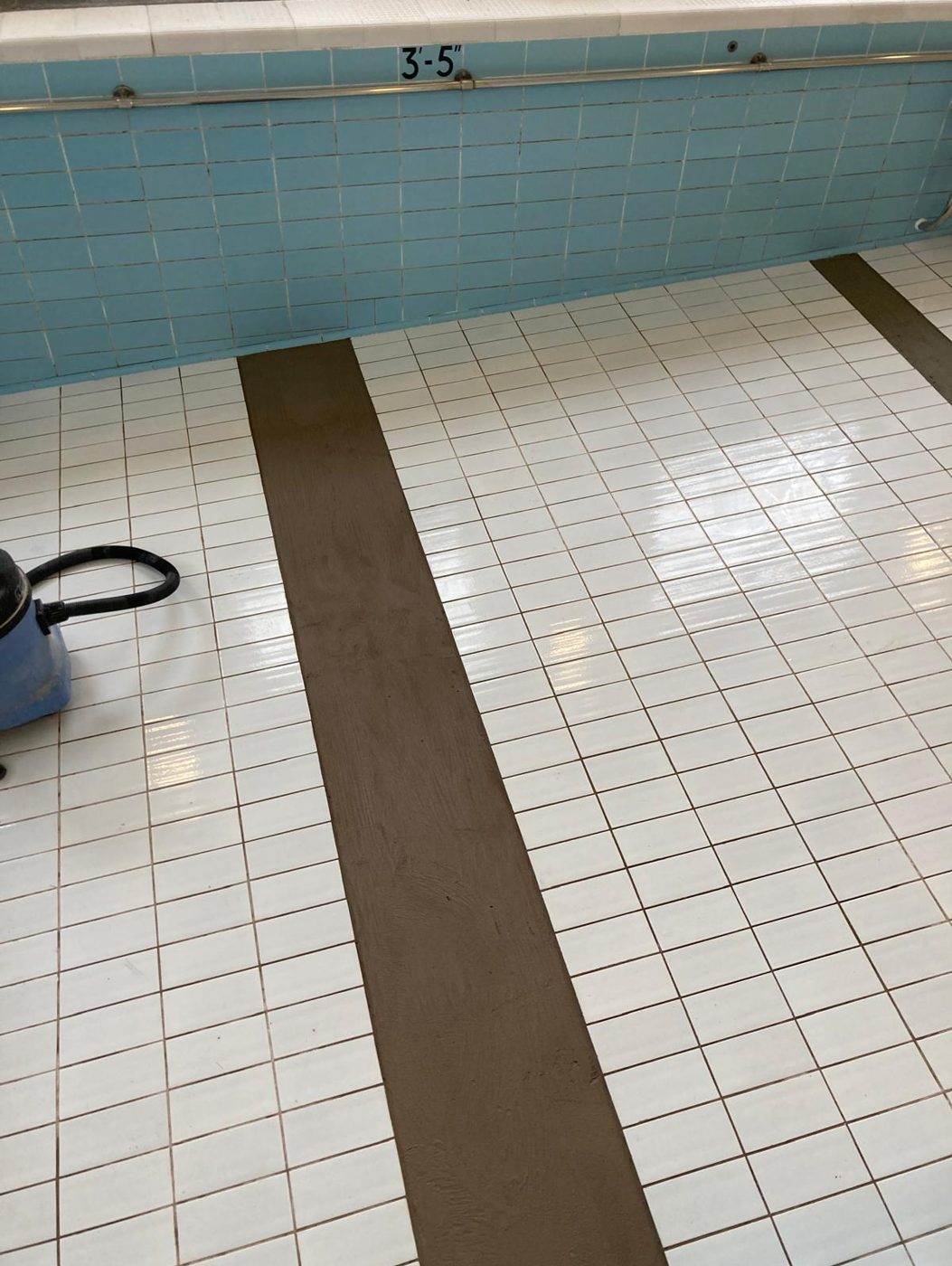
Why tile-on-tile is tempting
Stripping a pool is noisy, dusty and slow, and it fills skips. Fixing new tiles straight onto the old ones looks like a way to skip all of that, and in some dry areas tile-on-tile is a recognised method when the conditions are right.
A pool is a different case. The new tiles depend entirely on the old tiles staying bonded, under water, through years of heating, cooling, draining and refilling. That is a hard test for any bond.
The old tiles become your background
New tiling can only be as good as what it is fixed to. If any tile underneath is hollow or loose, or the render behind it is parting from the shell, the new layer sits on that weakness and fails with it.
Tapping over the old tiles helps find poor areas, but it is a screening check and cannot prove every tile is sound. And there is an awkward truth here: a pool often needs new tiles because the old ones are failing. That is exactly when tiling over them is least likely to last.
Bonding to a glazed face
Glazed and vitrified pool tiles have dense, smooth faces that most adhesives do not grip well without the right preparation. Years of scale, body oils and cleaning residues have to come off completely, and the system may call for abrading or priming the surface.
Whether any adhesive will hold new tiles to old ones under permanent immersion is for the adhesive system manufacturer to say, not the tiler. Check the manufacturer's guidance for that exact use, preferably in writing. If it does not cover it, do not do it.
Thickness, levels and fittings
A second layer of tile and adhesive builds up the surface, and in a pool almost everything is set to the original finished level.
- Inlets, outlets, lights and skimmer openings that sat flush would end up recessed behind the new face.
- Overflow channels, grating levels and edge details may no longer line up with the new tiling.
- Step treads and risers change size, and consistent step heights matter for safety.
- Handrail, ladder and other fixings may need resetting.
- The extra weight hangs on the old adhesive bed, which was never designed to carry it.
Movement joints and waterproofing
Movement and perimeter joints have to carry through every layer in the same place. Where the existing joints have been filled with rigid grout, or were never formed, tiling over them buries the problem and the new layer cracks along the same lines.
Tiles are not usually the waterproof layer in a pool. Covering them hides the old surface, which makes any later investigation of leaks or failures harder. If the specification calls for a waterproofing membrane, its suitability over existing tiles and under immersion is again a question for the system manufacturer.
The usual route: assess, remove, repair, retile
With the pool drained, the tiles are tapped and inspected, and where needed a tile or two is lifted to see the bed and render. The old tiles and adhesive are then stripped back to a sound background.
Weak or hollow render is cut out and renewed, waterproofing goes on where specified, and the new tiles are solid bedded in an adhesive suited to immersion, then grouted. Movement joints are formed in a flexible sealant, every product is left to cure as its data sheet requires, and the pool is refilled steadily.
It is more work up front. But you end up knowing what the new tiles are fixed to, which is the whole point.
Before deciding on new tiles at all
If the problems are local, such as a few hollow tiles, a cracked step nosing or worn grout, the pool may not need new tiles everywhere. Targeted repairs and a regrout can be the better answer, and our guide to retiling or repairing a pool covers that choice.
Dan and Jay will tell you plainly which route they think suits your pool once they have seen it.
Common questions
Can you tile over existing pool tiles?
In a submerged pool it is usually not advisable. It might be considered only where every existing tile is sound and the adhesive system manufacturer supports tile-on-tile under permanent immersion. Even then, fittings, channels and steps need reworking, so stripping and retiling is normally the better route.
Is tiling over old pool tiles cheaper?
It can look cheaper because it avoids the strip-out. If the old tiles let go underneath, though, you then have two layers to remove instead of one, plus the cost of another closure.
Can mosaic go over existing pool tiles?
The same problems apply. Mosaic does not change the fact that the new layer depends on the old tiles staying bonded, and it adds the same thickness at fittings, channels and steps.
What about tiling over tiles on the pool surround?
Surrounds are not permanently immersed, so tile-on-tile is more often considered there, using a system its manufacturer supports. The old tiles still need to be sound, and falls to drains, channel levels, thresholds and slip resistance all need checking.
How can I tell if my existing pool tiles are sound?
Drain the pool and have the tiles tapped and inspected, with a tile lifted where the sound is doubtful. That shows where problems are, but it cannot prove every tile across the pool is bonded, which is one reason tile-on-tile is a risk.