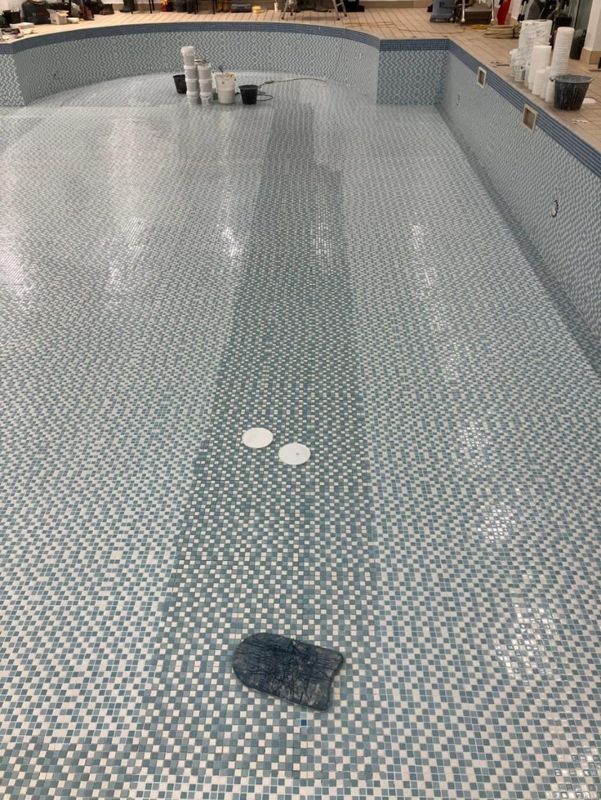
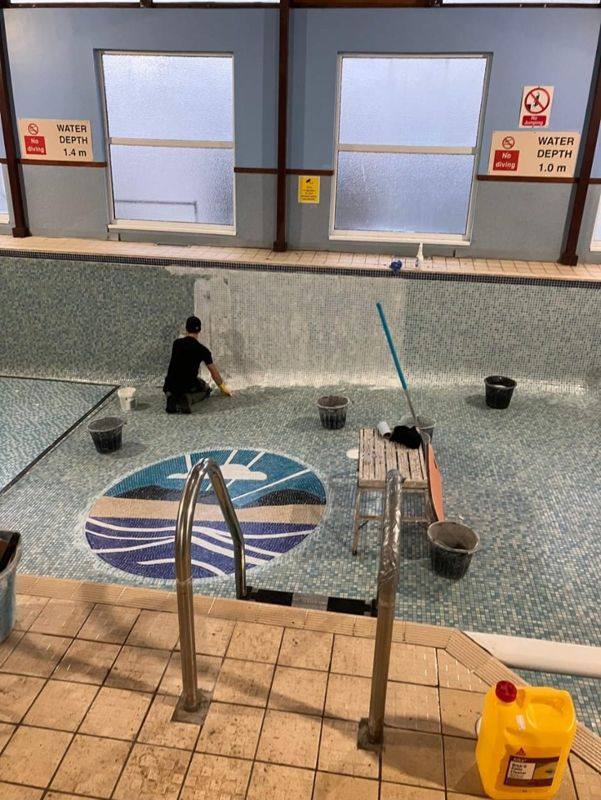
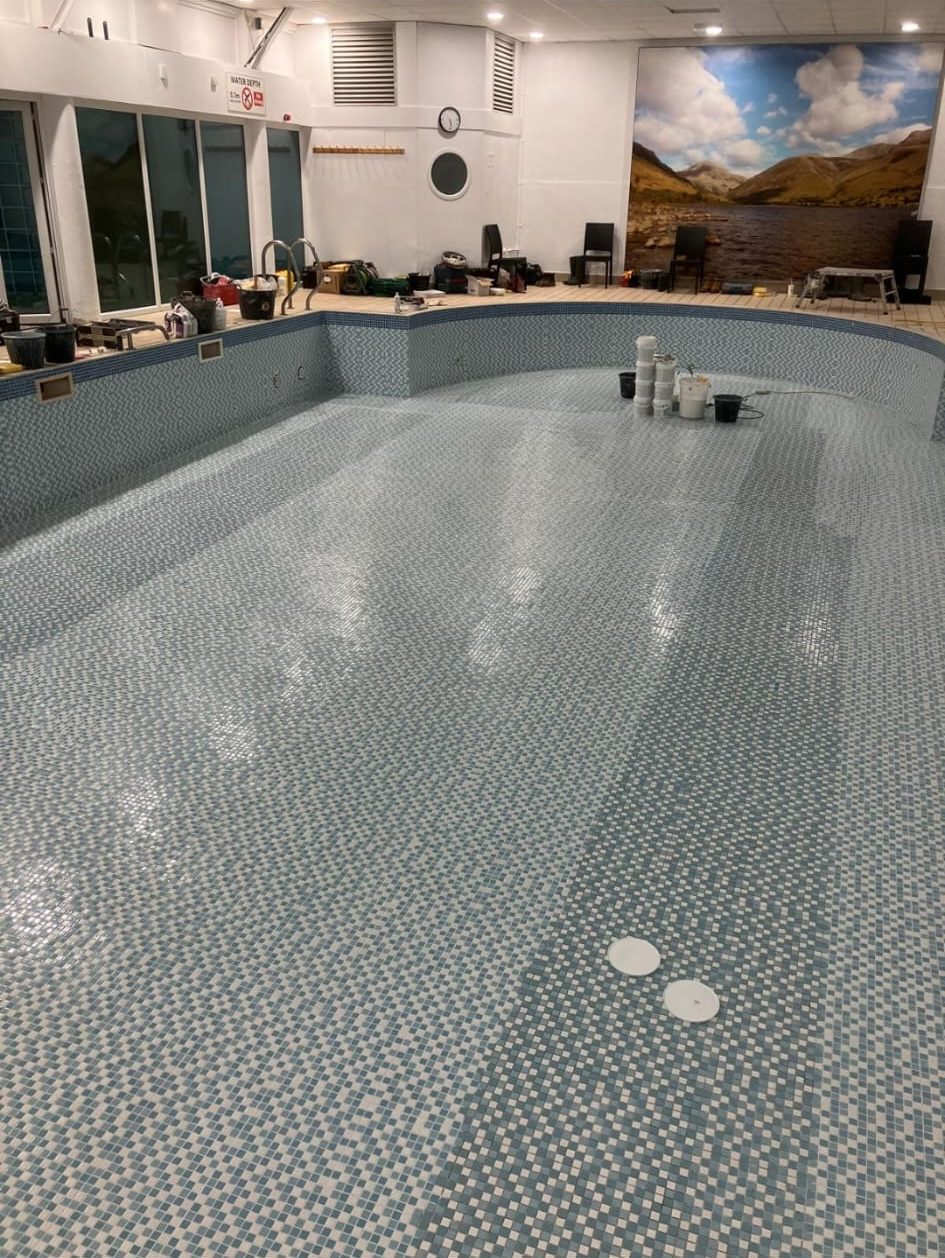
Mosaic suits curves, steps, coves and decorative features, because small pieces follow changes in shape. Larger tiles suit flat, straight surfaces and give fewer joints, but they need a flatter background, careful cutting and a solid bed beneath each tile. Neither is right for every pool: shape, background, design and maintenance decide it.
The main difference
Mosaic tiles are small pieces, usually supplied on sheets, that can follow curves and changes in level. Larger format tiles cover more area per piece and give a cleaner, more open look on flat surfaces.
Plenty of pools use both: larger tiles on flat floors and walls, mosaic on curves, steps or features. The choice is often made area by area rather than for the whole pool.
It is not only a question of looks. Tile size changes the background preparation, the number of joints, how markings are formed, how repairs look and how much cleaning the finish needs.
Where mosaic works well
Mosaic earns its place wherever the surface changes shape. Each piece is small, so the sheet follows a curve without big cuts or wide joints.
- Curved walls, freeform shapes and leisure pools.
- Steps, coves and rounded transitions.
- Decorative features, emblems and patterns.
- Spa pools and seating with tight radii.
- Areas where many small cuts would otherwise be needed.
Where larger tiles work well
On flat, straight surfaces, larger tiles give a clean look with fewer joints to install and maintain.
- Straight walls and flat floors in rectangular pools.
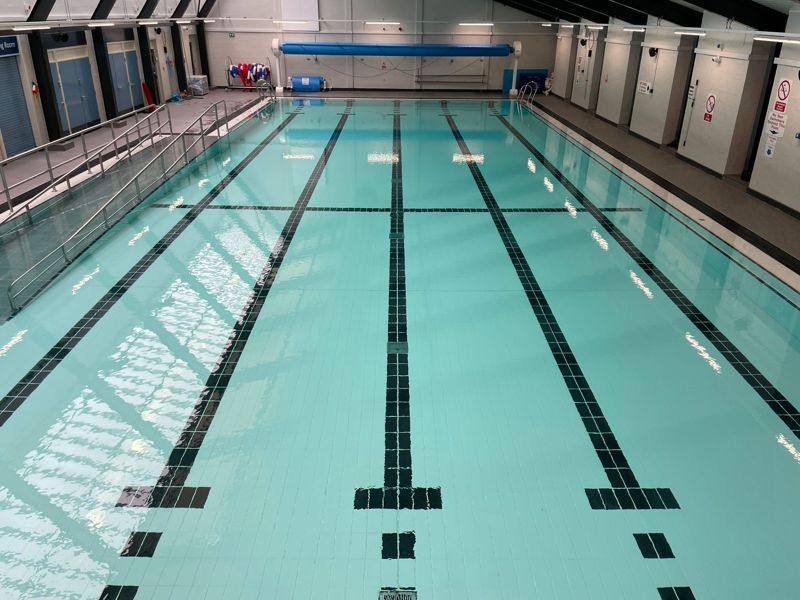
- Lane pools where markings are set out on a regular grid.
- Surrounds where fewer joints may simplify cleaning.
- Designs that suit a calmer, less busy appearance.
Joints, grout and maintenance
Mosaic has many more grout joints per square metre than larger tiles. That means more grout to install, clean and eventually maintain. Joint quality matters a great deal, because grout makes up a much bigger share of the visible surface.
In an immersed pool every tile, mosaic included, should be solidly bedded with no voids behind it. That is harder to achieve under a large tile, and usually means back-buttering the tile as well as combing the bed. A single damaged large tile is also a bigger area to cut out and replace.
So grout choice matters more with mosaic. A pool-suitable grout chosen for the tile surface, joint width and pool use, packed fully into the joints and washed off within its working time, makes a visible difference to how the finish looks and wears.
Background flatness and fixing
Larger tiles show any unevenness in the background, so walls and floors usually need to be flatter before tiling.
Mosaic is more forgiving of gentle curves, but the background still has to be sound and well prepared. The sheet backing matters too. Manufacturers say how their sheets should be fixed and whether a given backing is suitable for immersion, and that guidance should be followed.
Markings, steps and safety details
Lane lines, targets, depth markings and step edges need to be clear and well defined. With larger tiles these are usually formed from whole tiles or strips in a contrasting colour laid to a grid. With mosaic, markings can be formed from contrasting pieces or sheets, and curves can be followed more closely.
On steps, contrasting nosings or edge pieces help users see each tread. Both mosaic and larger tile ranges may include purpose-made step and edge pieces, and where people stand the surface should have suitable slip resistance based on the manufacturer's data.
Repairs and future matching
Repairing a small area of mosaic usually means cutting out and replacing pieces or part sheets. Colour matching can be difficult with older mosaics, especially blends of several colours.
With larger tiles, a repair replaces whole tiles, so each one is more visible if the shade differs. In both cases keeping spare tiles from the original batch makes future repairs easier.
Making the choice for your pool
Look at the shape of the pool, the condition and flatness of the background, the look you want, the markings needed and how the pool will be cleaned. On a retile, the existing background and features may limit what is practical without extra preparation.
Ask a specialist to explain how each option would work in your pool, and what preparation it would need, before you commit.
Cost is shaped by more than the price of the tile. Preparation, the number of cuts, the time needed to set out markings and the volume of grout all vary between options, so it is worth comparing complete proposals rather than tile prices alone.
Common questions
Is mosaic harder to maintain than larger tiles?
Usually, yes. There are far more grout joints to keep clean and eventually maintain. A suitable, well-installed grout and a sensible cleaning routine help, but the demand is generally higher than with larger tiles.
Can I change from mosaic to larger tiles in a retile?
Sometimes, but larger tiles may need a flatter background, and curves or steps may still need mosaic or special pieces. The existing shape, levels and fittings all affect what is practical.
Are mosaic pools more likely to lose tiles?
Not inherently. Tile loss usually relates to bedding, background, movement or water conditions rather than tile size alone. Both mosaic and larger tiles can perform well when the system is suitable and correctly installed.
Do larger tiles need a different adhesive from mosaic?
They may. The adhesive has to suit the tile size, material, background and immersion, and larger tiles need careful technique to get full coverage. Follow the adhesive and tile manufacturers' recommendations.