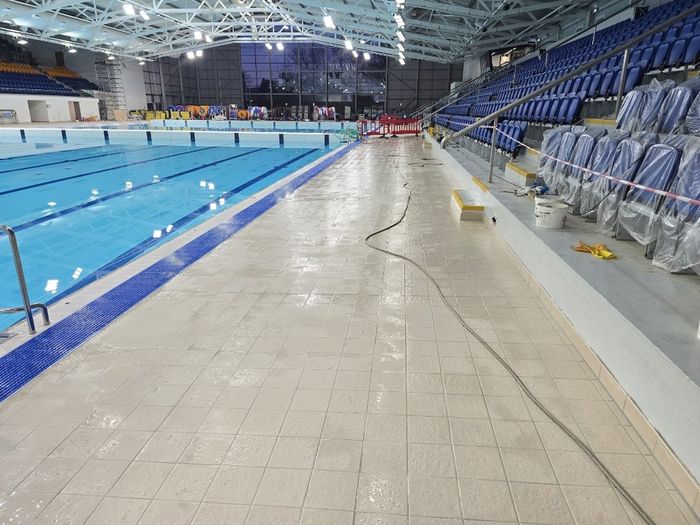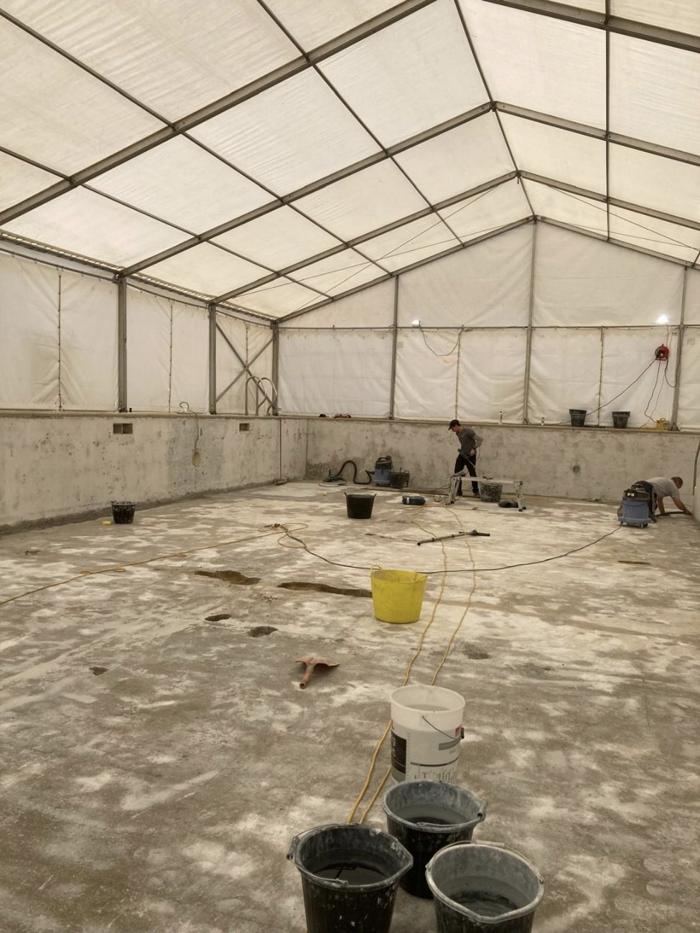
The best tile depends on who uses the pool and where the tile is going. Public and school pools need high slip resistance on surrounds, steps and shallow areas, with the highest grades usually specified for SEND school and hydrotherapy pools. Private pools allow a wider choice of porcelain, ceramic or mosaic. In almost every case, choose tiles made for swimming pools, check the manufacturer's slip resistance data, bear in mind that natural stone needs more maintenance, and avoid extra-large formats and tiling over existing tiles inside the pool.
Start with tiles made for swimming pools
Pool tiles sit permanently in treated water, go through temperature changes and are cleaned frequently. Choose tiles that the manufacturer states are suitable for swimming pools and for the specific area, whether that is immersion, the surround, steps or changing areas.
Most pools are tiled in porcelain, ceramic or mosaic. Many ranges include matching anti-slip floor tiles, step treads, edge pieces, backing tiles and drainage channel tiles, so the pool can be finished consistently from the surround to the pool floor.
Understanding slip resistance ratings
Slip resistance is published in several different ways, and results from different test methods cannot be compared directly. Always check which method a figure relates to.
- Pendulum test (PTV): the method HSE generally refers to in the UK for assessing floors. A wet Pendulum Test Value of 36 or above is classed as low slip potential.
- DIN 51097 (A, B, C): a barefoot, wet ramp test widely used by pool tile manufacturers. Class A is the lowest and Class C the highest, with Class C tiles staying slip resistant on a ramp angle of more than 24 degrees.
- DIN 51130 (R9 to R13): a ramp test carried out with shoes and oil. It is useful for shod areas, but on its own it is not the right rating for wet barefoot areas such as a pool surround.
- Laboratory results apply to new tiles. Wear, contamination and cleaning all affect how a floor performs in use.
Leisure centres and public pools
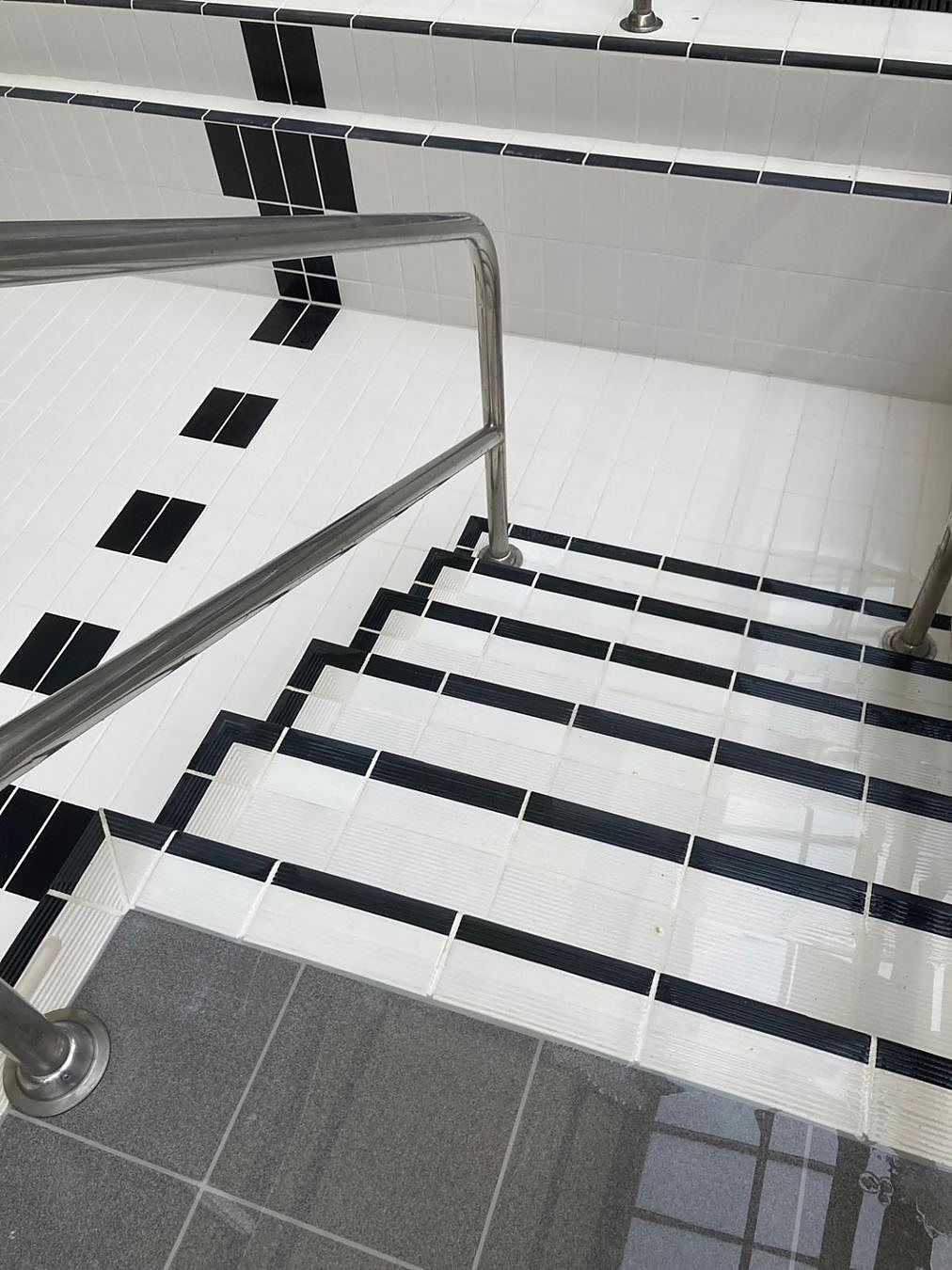
Leisure centres and other public pools need a high anti-slip rating wherever people walk barefoot. Manufacturer guidance commonly places pool surrounds in Class B, and steps and ladders into the water, sloping pool edges and steeper ramps in Class C.
Inside the pool, anti-slip tiles are typically used on the floor of the shallow end and the areas where bathers stand. The floor usually changes to a glazed tile once the water reaches a depth where the average person can no longer stand. Some manufacturer guidance uses 80 cm of water depth as its reference point for slip-resistant pool floors, so the exact change point should follow the specification and the operator's risk assessment.
Lane lines, depth markings and step edges also need to stay clearly visible, so contrasting nosings and marking tiles are chosen alongside the main tile.
SEND schools and hydrotherapy pools
Special schools for pupils with special educational needs and disabilities (SEND) and hydrotherapy pools usually call for the highest anti-slip grade available, typically Class C, across steps, ramps, surrounds and the pool floor where users walk and stand. Many users enter the water with assistance, move slowly or are unsteady on their feet, so grip is a priority throughout.
These areas often use heavily profiled anti-slip tiles, such as disc-faced finishes. A more pronounced profile holds more dirt, so it needs a suitable cleaning regime to keep performing as intended. The specification should be agreed with the school or operator and their risk assessment, using the manufacturer's published data.
Private and feature pools
Private, hotel and feature pools are where the widest variety of tiles is seen, and the choice is usually led by the client's preference. Porcelain, ceramic and mosaic are all available in a wide range of colours, sizes and finishes.
Appearance can lead, but practical points still apply. Steps, entry points, shallow areas and the surround still need suitable slip resistance, and the tiles must be rated for swimming pool use.
Natural stone and travertine
Natural stone such as travertine is valued for its appearance and is most often seen around outdoor pools in hotter climates, where it stays comfortably cool for bare feet and tumbled finishes offer good grip when wet. It can perform well when a suitable grade is chosen and it is sealed and maintained.
However, it is porous and needs regular sealing. If this is neglected, it can stain quickly, and acidic cleaners, descalers and salt water can etch or pit the surface over time. For most UK pools, porcelain or ceramic tiles offer a similar appearance with far less maintenance, which is why we generally recommend them.
Why extra-large tiles are rarely suitable
Extra-large format tiles are generally not a good idea inside swimming pools. Pool floors are usually laid to falls, and smaller tiles and mosaics follow those falls and changes of level far more easily.
Large tiles also need a very flat background. Where walls and floors have not been prepared accurately, they can only be laid flat by building out the adhesive bed, and building out should be kept to a minimum in a swimming pool. A thick bed increases the risk of voids behind the tile, and of the finished surface ending up out of line with fittings, channels and steps.
Do not tile over existing tiles in the pool
Tiling over existing tiles is not recommended inside a swimming pool. The new tiles depend entirely on the old ones staying bonded under water, and the extra thickness affects fittings, channels and step heights. The reliable approach is to remove the old tiles, repair the background and retile. Our guide to tiling over existing pool tiles explains why in more detail.
Every pool needs its own assessment
No single tile suits every pool. The right choice depends on who uses the pool, the condition of the background, the pool's shape and falls, and how it will be cleaned. Outdoor pools also need frost-resistant tiles.
We supply and fit all kinds of pool tiles, including anti-slip floor tiles, step treads, edge and drainage tiles, and we also fit tiles supplied by the client. We assess each pool before recommending a tile, so please send us your plans or photos.
Common questions
What are the best tiles for around a swimming pool?
For most pool surrounds, a porcelain or ceramic anti-slip tile rated for wet barefoot areas is the most practical choice, typically Class B or higher under DIN 51097. Outdoor surrounds also need frost-resistant tiles.
What slip rating do swimming pool steps need?
Steps and ladders into the water are commonly specified as Class C under DIN 51097, the highest barefoot rating. Always check the manufacturer's data and the operator's risk assessment.
What tiles are used in SEND school and hydrotherapy pools?
Usually the highest anti-slip grade available, typically Class C, across steps, ramps, surrounds and the pool floor where users stand, often with a heavily profiled finish.
Do pool floors need anti-slip tiles all the way across?
Not usually. Anti-slip tiles are used where bathers stand, such as the shallow end, and the floor typically changes to a glazed tile where the water is too deep to stand.
Is travertine good around a pool?
It can be. Travertine is most common around outdoor pools in hotter climates, where it stays cool for bare feet and tumbled finishes grip well when wet. It is porous, though, and needs regular sealing to avoid staining and etching, so porcelain or ceramic is usually the more practical choice for UK pools.
Is natural stone good for swimming pools?
It can work when a suitable grade is chosen and it is sealed and maintained, but it is porous and can stain quickly if sealing is neglected. Porcelain or ceramic tiles are usually more practical.
Can you use large format tiles in a swimming pool?
Extra-large tiles are rarely suitable. Pool floors are laid to falls, and large tiles need a very flat background, which can mean building out the adhesive bed more than is advisable in a pool.
Is R11 good enough for a pool surround?
R ratings are tested with shoes and oil, so they are not the right measure on their own for wet barefoot areas. Look for a barefoot rating (DIN 51097) or a wet pendulum value as well.
Sources and further guidance
- HSE HSG179 Health and safety in swimming pools
- HSE Assessing the slip resistance of flooring
- AGROB BUCHTAL: Slip resistance in wet barefoot areas
- COBA: Slip resistance to DIN 51097 and DIN 51130
- Pool Research: travertine around pools
- TravertineMart: travertine and salt water erosion
This guide is general information, not legal, health or safety advice for a specific site. Pool operators should follow current official guidance and take advice from competent specialists.