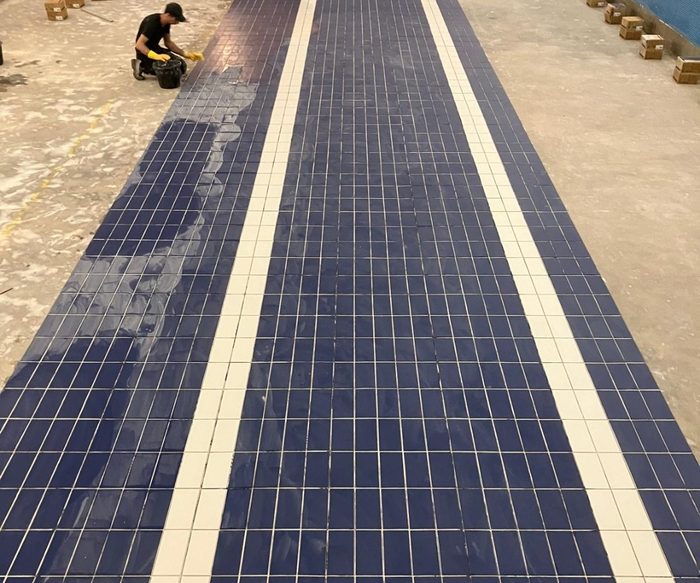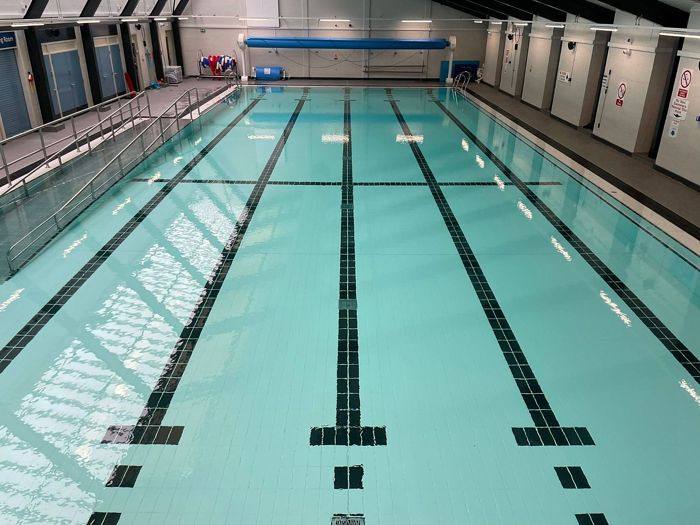
Use an adhesive that the manufacturer states is suitable for swimming pools, and follow the instructions on the bag for mixing, coverage and grouting times. One we often use is ARDEX X 77, a flexible, fibre-reinforced cement-based adhesive classed C2 TE S1. It is one of several good pool-suitable adhesives, and we choose the right one for each job. The adhesive only works as well as the preparation beneath it.

Why pool tiles need the right adhesive
A swimming pool is one of the hardest places to tile. The tiles are under water for years, the pool fills and empties, temperatures change and the water is treated with chemicals. An adhesive that is fine in a kitchen can fail in a pool, leaving hollow and loose tiles.
So the first rule is simple: use an adhesive that the manufacturer says is suitable for swimming pools. That information is on the bag and the product data sheet.
What to look for on the bag
- A clear statement that it is suitable for swimming pools.
- Its classification to BS EN 12004. C2 means an improved cementitious adhesive; S1 means deformable (flexible); T means reduced slip; E means extended open time.
- Suitability for the tile you are fixing, including mosaics and fully vitrified, low-porosity tiles.
- Mixing instructions and water ratio, pot life, open time and when tiles can be grouted.
- Any primer the manufacturer requires for the background.
An example we often use
One adhesive we often use on pool jobs is ARDEX X 77. Ardex describes it as a cement-based, flexible, fibre-reinforced adhesive for ceramic tiles and mosaics in internal and external situations, including swimming pools.
It is classed C2 TE S1 to BS EN 12004-1 and uses Ardex's MICROTEC fibre reinforcement. Ardex also says it holds large wall tiles without slipping, has an extended open time and needs no admixture for fully vitrified or low-porosity tiles. A rapid-set version, X 77 S, can be grouted after about 90 minutes on floors.
It is one example, not the only option: there are other good pool adhesives, and we pick the product to suit the tiles, the background and the programme. Whatever is used, check the bag says it is suitable for pools and follow the manufacturer's guidance.
Preparation matters as much as the product
The best adhesive will not save a poorly prepared pool. Tiles need to go onto clean, dust-free, sound surfaces, with the correct screed and render for a swimming pool beneath them.
Mixing matters too. Adding too much water weakens cement-based products, so adhesive and grout should always be mixed to the manufacturer's ratio. Tiles should be fully bedded, with no voids behind them for water to sit in.
Doing it right first time
Many early pool failures we see come down to the wrong materials or rushed work, not bad luck. A pool tiled with suitable materials, good preparation and fully filled joints, and kept in balanced water, gives you the best chance of a long life.
If you are planning works or have tiles coming loose, send us photos and we can talk you through the options.
Common questions
Can any tile adhesive be used in a swimming pool?
No. Use an adhesive the manufacturer states is suitable for swimming pools. General-purpose adhesives may not stand up to long-term immersion and pool chemicals.
What does C2 TE S1 mean?
It is a classification to BS EN 12004. C2 is an improved cementitious adhesive, T means reduced slip, E means extended open time and S1 means it is deformable, or flexible.
What mortar or adhesive is used for pool mosaics?
A pool-suitable, flexible cementitious adhesive is common for mosaics. ARDEX X 77, one we often use, is stated as suitable for ceramic tiles and mosaics in swimming pools; other pool-suitable adhesives are available.
How soon can pool tiles be grouted after fixing?
It depends on the adhesive. Rapid-set products can often be grouted within a couple of hours; standard-set products take longer. Always follow the grouting time on the bag.
Sources and further guidance
This guide is general information, not legal, health or safety advice for a specific site. Pool operators should follow current official guidance and take advice from competent specialists.